
Introduction
In the modern software development lifecycle, documentation often suffers from fragmentation. Teams juggle separate tools for text editing, diagramming, code repositories, and project management, leading to outdated information and siloed knowledge. This disconnect creates a significant bottleneck where architectural decisions made in design tools rarely make it accurately into final documentation, resulting in “documentation drift.”
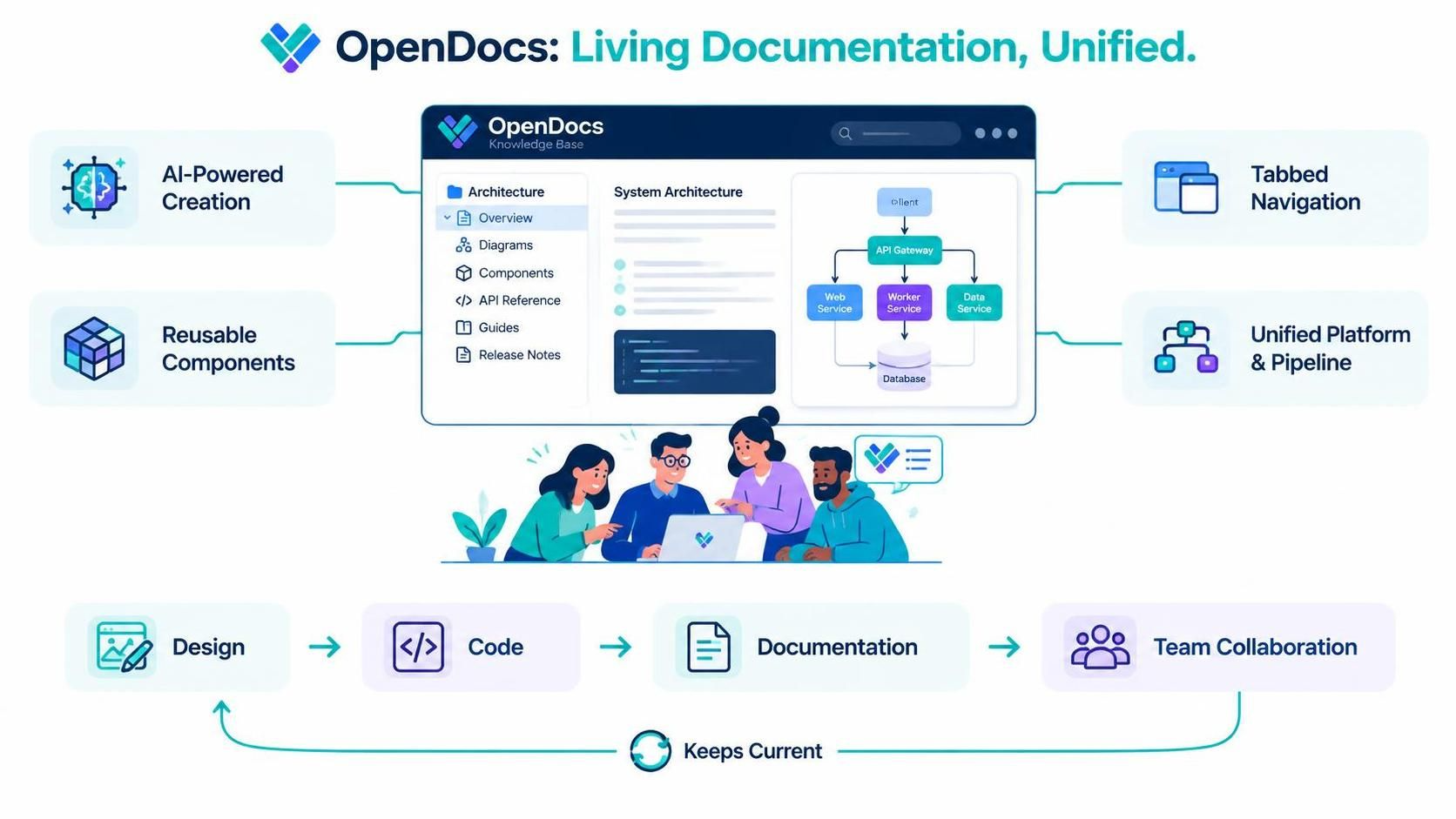
Visual Paradigm OpenDocs emerges as a robust solution to this challenge. It is not merely a standalone editor but a web-based, AI-powered knowledge base that seamlessly integrates rich-text writing with visual diagramming. As part of the broader Visual Paradigm ecosystem, OpenDocs serves as a centralized workspace designed to create “living” technical documentation. By combining dual text editors, AI-assisted diagram generation, and a unified pipeline for syncing assets across desktop and online environments, OpenDocs enables teams to maintain accurate, visually rich, and easily shareable documentation without context switching.
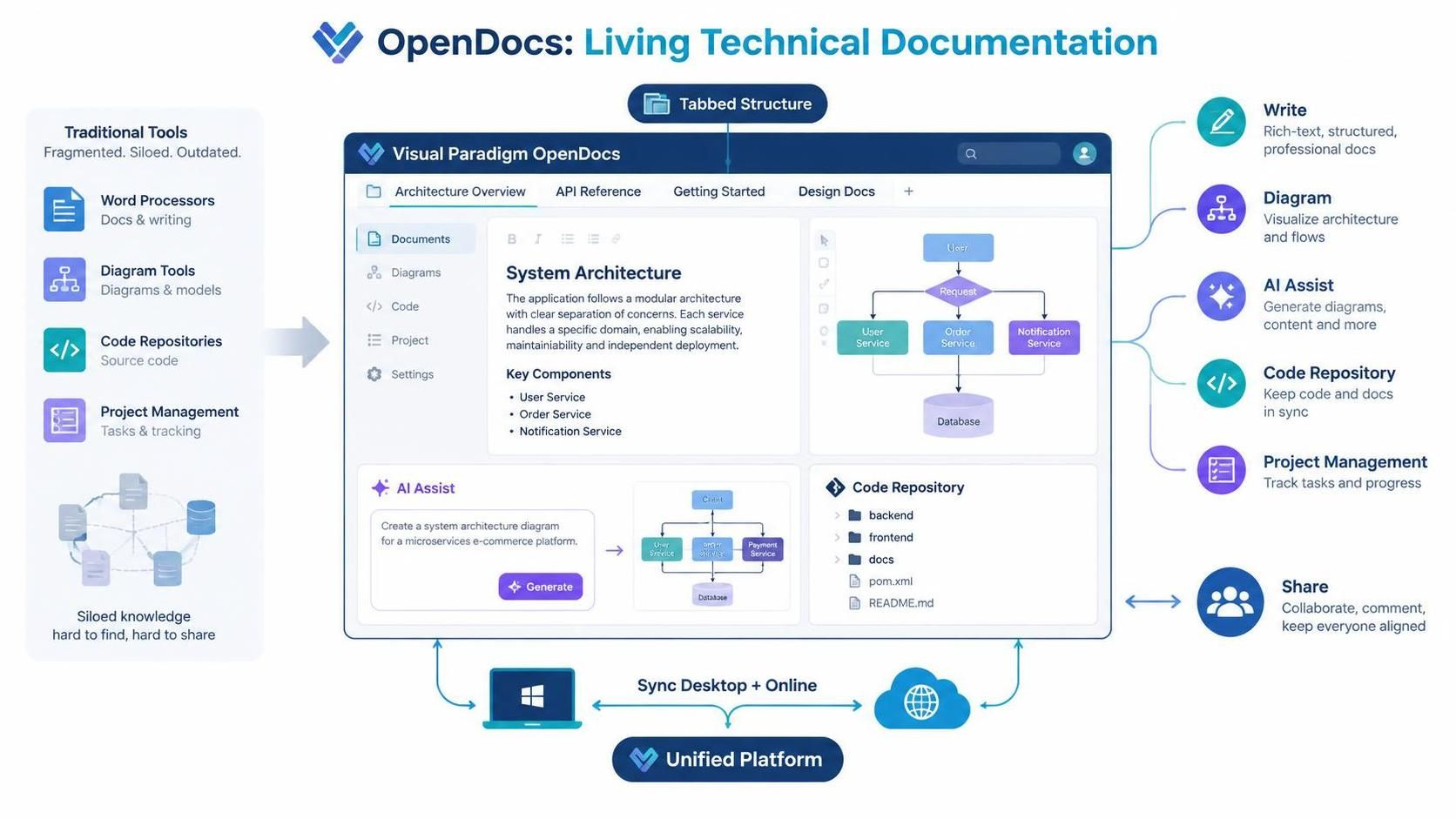
This guide explores how to leverage OpenDocs’ core features, its new tabbed structures, and its deep integration within the Visual Paradigm Unified Platform to streamline your documentation workflow.
Core Features of Visual Paradigm OpenDocs
OpenDocs is built on the premise that documentation should be as dynamic as the software it describes. Its feature set is designed to reduce friction between writing and visualizing, ensuring that technical specifications remain clear and up-to-date.
Dual Text Editors for Flexible Authoring
Recognizing that different team members have different preferences, OpenDocs offers two distinct editing modes:
-
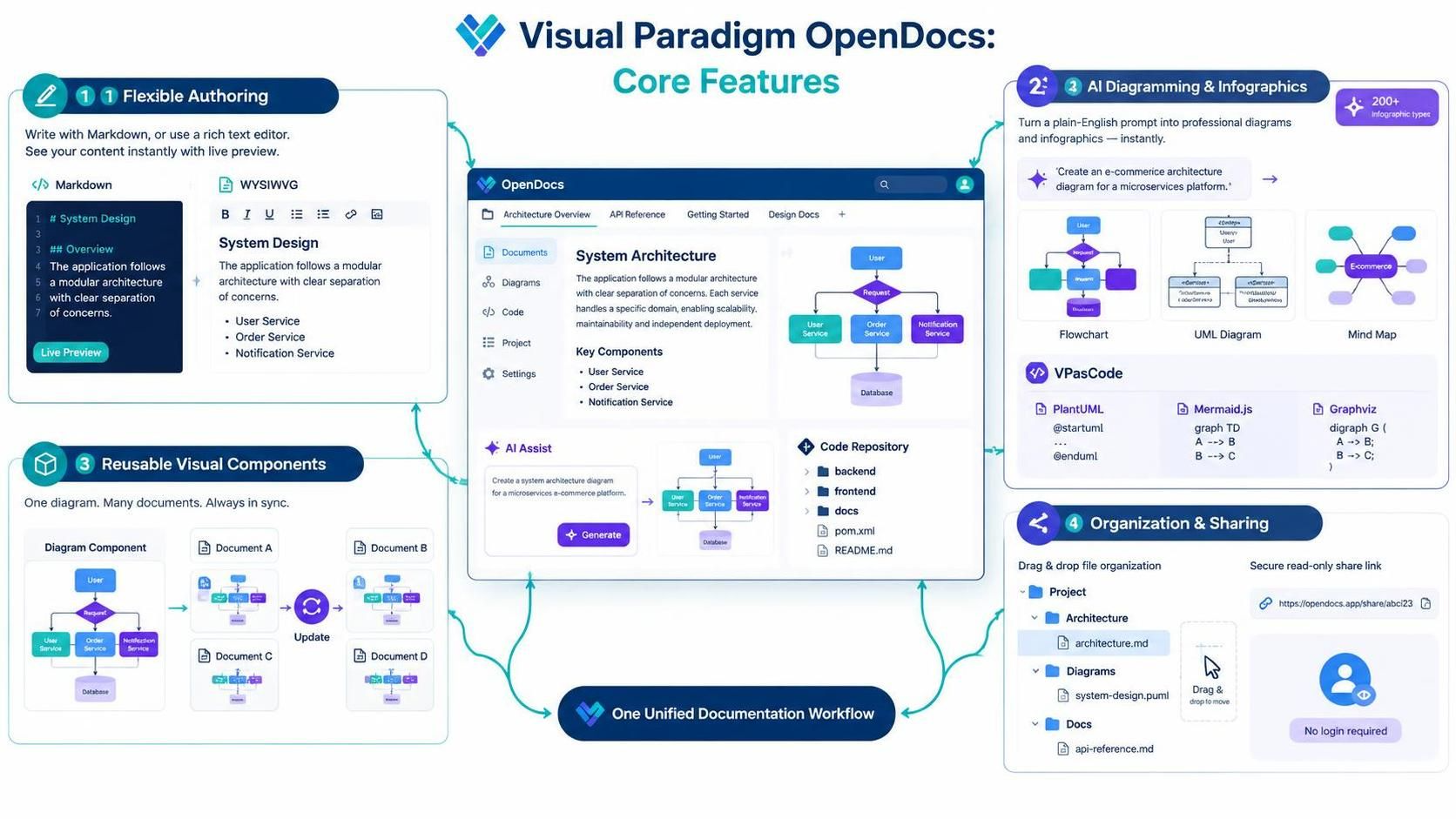
Markdown Editor: Ideal for developers and technical writers who prefer code-like syntax. It features a split-pane live preview, allowing users to see the rendered output while typing standard Markdown.
-
WYSIWYG Visual Editor: A standard rich-text interface for users who prefer a word-processor-like experience, making it accessible for product managers and stakeholders who may not be familiar with Markdown syntax.
AI-Powered Diagramming and Infographics
One of OpenDocs’ standout capabilities is its ability to generate visuals from plain-English prompts. Users can create flowcharts, UML diagrams, and mind maps instantly, reducing the time spent on manual drawing. Recent updates have expanded this capability to include over 200 types of AI-generated infographics. Additionally, for teams that prefer “architecture as code,” OpenDocs supports VPasCode, allowing the creation and editing of text-based diagrams using PlantUML, Mermaid.js, and Graphviz.
Reusable Visual Components
To maintain consistency across large projects, OpenDocs allows users to embed single-page diagrams or create reusable component pages. When a component is updated, the changes automatically reflect across all documents where it is embedded. This ensures that stakeholders always view the most current version of critical assets, such as system architecture diagrams or API schemas, without needing to manually update multiple files.
Hierarchical Organization and Sharing
Content is organized in a drag-and-drop file system tree, making navigation intuitive for both authors and readers. For distribution, OpenDocs offers one-click sharing via secure, read-only URLs. This allows external stakeholders or team members to access the entire knowledge base without needing to log in, significantly simplifying the review and approval process.
New Capabilities: Tabbed Structures for Enhanced Navigation
To further improve readability and modularity, Visual Paradigm introduced two distinct tabbed structures in late 2026. These features help reduce long-scrolling pages and keep related content organized, enhancing the user experience for complex documentation sets.
1. Tabbed Folders (Navigation Tree Level)
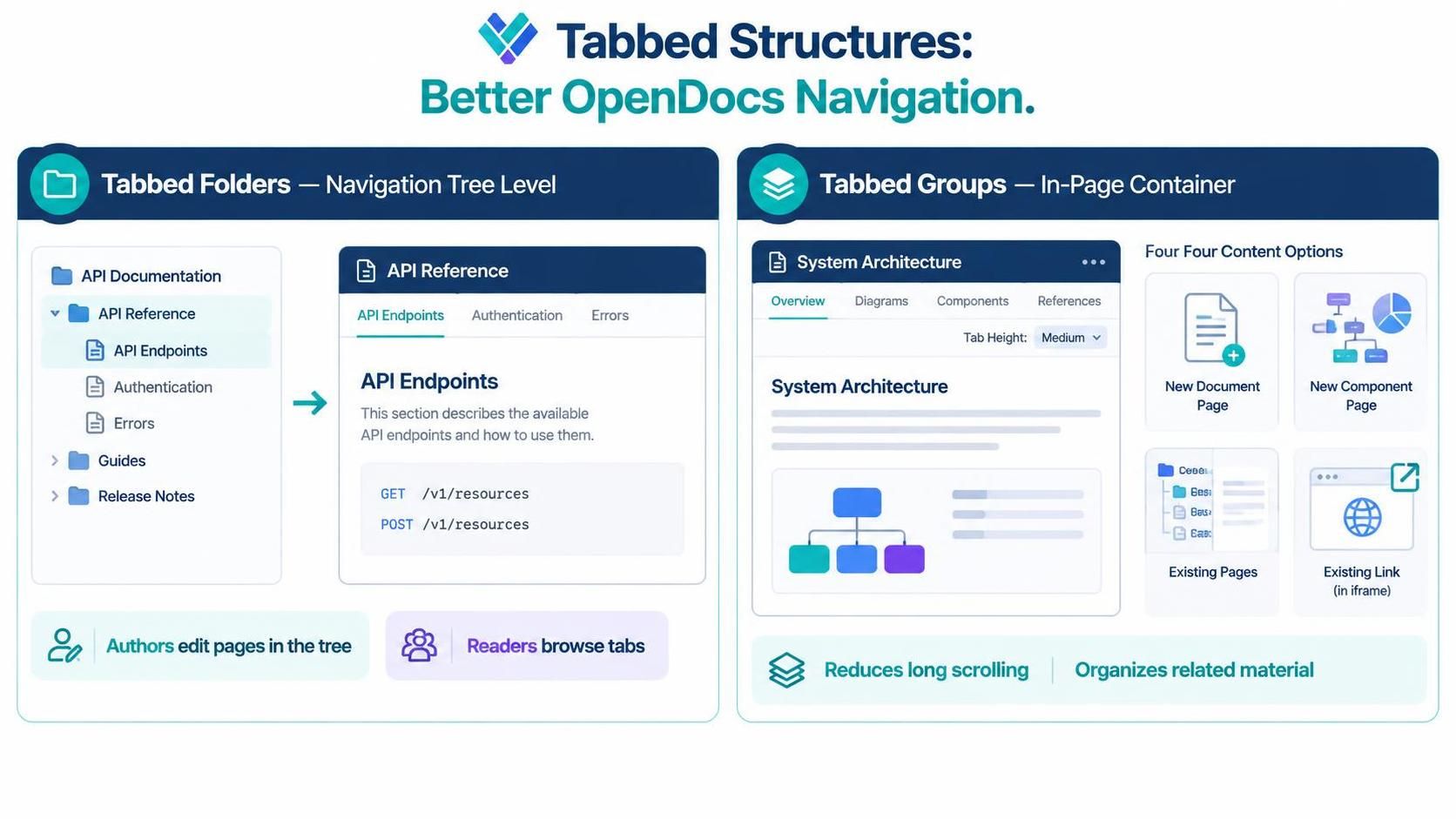
Tabbed Folders transform a standard folder in the sidebar into an interactive tabbed view.
-
Functionality: Each child page within the folder becomes a tab.
-
Workflow: Authors continue to edit individual pages in the traditional tree structure, while readers experience a seamless tabbed interface when browsing the folder. This is ideal for grouping related topics, such as API endpoints, module specifications, or user stories, under a single parent category.
2. Tabbed Groups (In-Page Container Level)
Tabbed Groups are layout components inserted directly into a page, allowing for multi-content views within a single document.
-
Setup: Users can insert tabs via the toolbar, customize captions, and set specific heights.
-
Content Types: Each tab can host various content types, including:
-
New Document Page: A fresh page embedded within the tab.
-
New Component Page: A dedicated view for diagrams or charts.
-
Existing Pages: A Table of Contents (TOC) tree on the left with content on the right, combining multiple existing pages.
-
Existing Link: An iframe loading external websites or web tools, enabling integrated references without leaving the documentation environment.
-
Integration Through the Unified Platform and Pipeline
The true power of OpenDocs lies in its integration with the wider Visual Paradigm ecosystem. It is not an isolated tool but part of a unified platform that connects desktop modeling, online collaboration, and automated pipelines.
The Visual Paradigm Pipeline
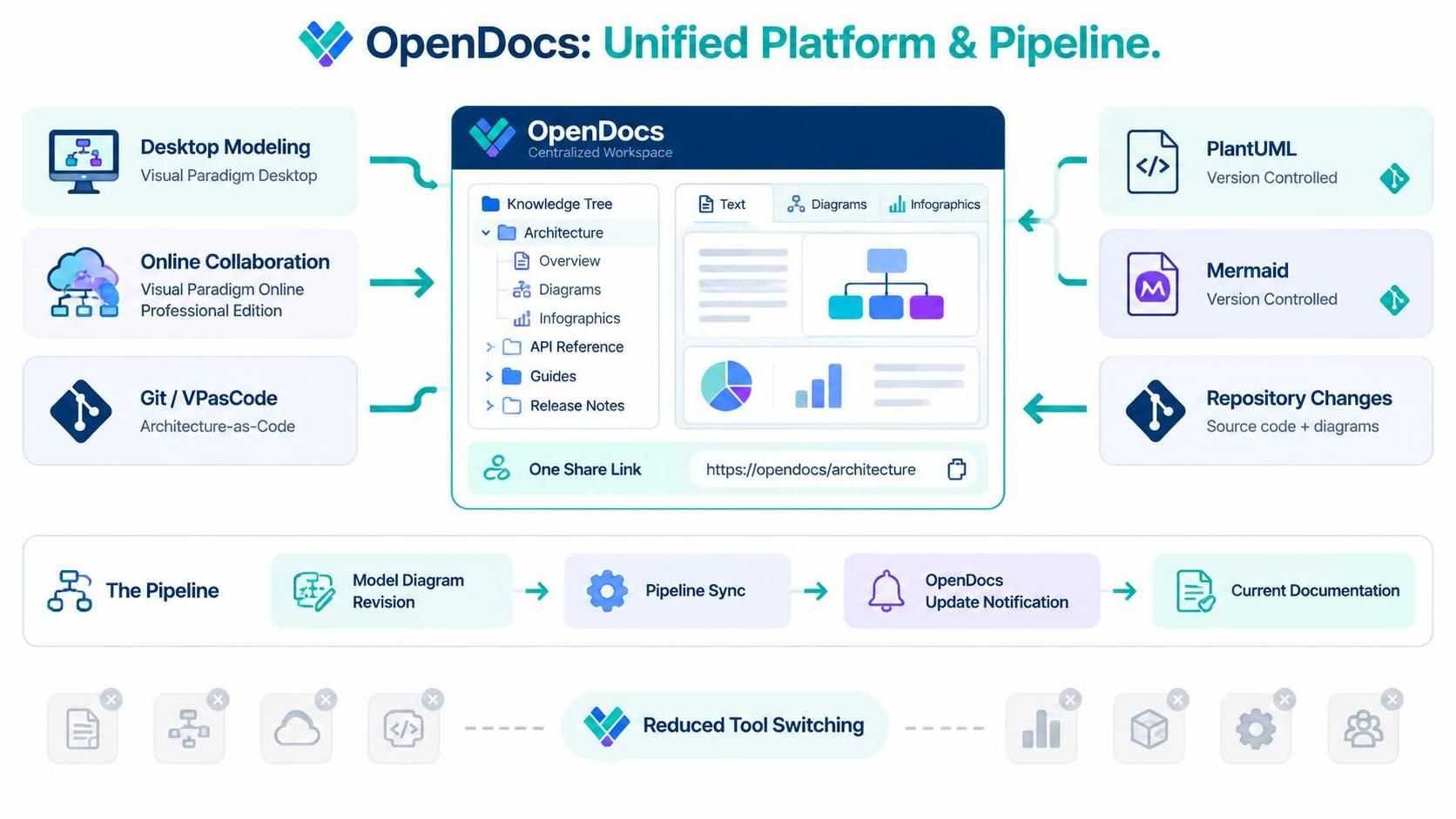
Teams using Visual Paradigm Desktop or the Professional Edition of Visual Paradigm Online can leverage the Pipeline Sync feature. This allows users to push diagram revisions directly from their modeling tools to OpenDocs. When updates are available, OpenDocs notifies users, ensuring that the documentation always reflects the latest architectural decisions made in the design phase.
Architecture as Code
For teams practicing DevOps and GitOps, the integration of VPasCode means that diagrams can be version-controlled alongside source code. Changes to PlantUML or Mermaid scripts in the repository can be reflected in OpenDocs, creating a self-updating documentation pipeline that bridges the gap between development and documentation.
Centralized Workspace
By keeping text, diagrams, and infographics in one place, OpenDocs eliminates the need to switch between Confluence, Draw.io, and GitHub Wikis. The unified platform ensures that all visual assets are stored centrally, accessible via the same hierarchical tree, and shareable through a single link.
The Visual Paradigm Ecosystem: How the Pillars Work Together
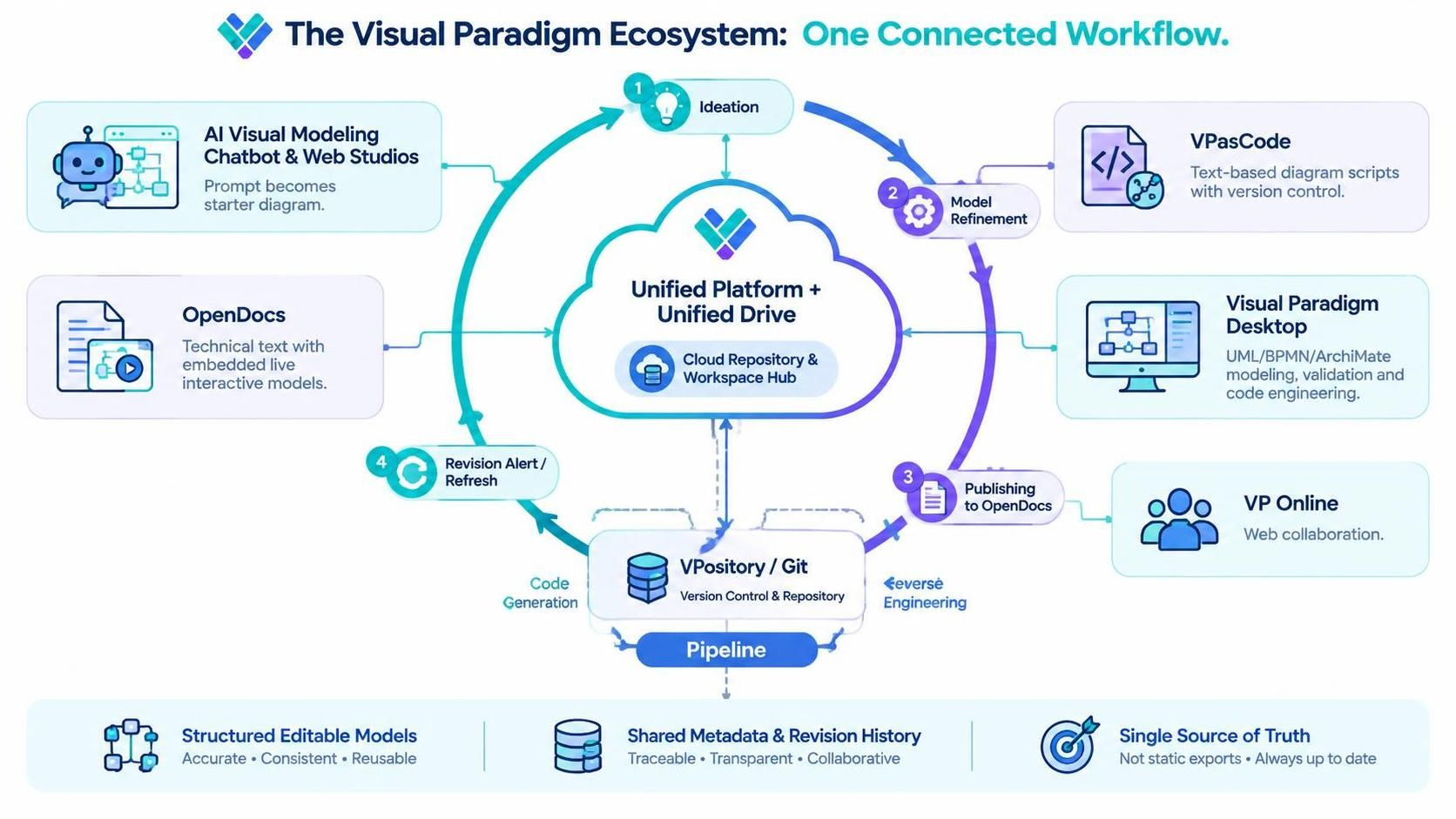
The Visual Paradigm Unified Platform connects desktop modeling, cloud tools, AI diagramming, and living documentation through a centralized cloud storage layer and an automated transit network called the Pipeline. Rather than relying on static image exports and manual file transfers, this architecture preserves editable model intelligence across every stage of software design and project documentation.
Core Components of the Ecosystem
Each specialized tool handles a specific phase of development while feeding into the same underlying project repository:
-
Unified Platform and Unified Drive: The Unified Platform serves as the main workspace launcher for over 100 web applications and desktop utilities. Beneath it, Unified Drive acts as a drive-like central repository that automatically indexes every diagram, model, and document created across the suite.
-
AI Visual Modeling Chatbot and Web Studios: These browser-based utilities turn natural-language prompts into initial diagrams, workflows, and architectures. Teams use them to overcome blank-page friction and generate baseline visuals rapidly.
-
VPasCode: This browser-based Diagram-as-Code environment lets developers create and edit diagrams using text syntax. It integrates smoothly with version-control workflows and code-review conventions.
-
Visual Paradigm Desktop: VP Desktop provides heavy-duty local modeling, validation, code generation, and reverse engineering. It turns early sketches into structured, standard-compliant UML, BPMN, and ArchiMate models.
-
OpenDocs: OpenDocs is a collaborative knowledge management and documentation workspace. Unlike standard wikis that rely on flat screenshots, it embeds live, interactive models directly alongside technical text.
Maintaining a Single Source of Truth
Visual Paradigm prevents data silos and documentation drift by treating diagrams as structured, linked entities rather than isolated files:
-
Centralized Model Storage: Every asset created in web apps or desktop environments lives inside Unified Drive or a connected team repository like VPository. Teams access the exact same authoritative project data without duplicating files across local hard drives.
-
Structured Editable Models: Artifacts retain their underlying metadata, element relationships, and revision history. Updating a class or component in one view updates its underlying definition across the project.
-
Bidirectional Engineering Sync: VP Desktop connects visual models directly to source code repositories. Teams can generate code from diagrams or reverse-engineer code changes back into models so architecture never drifts from implementation.
How the Shortcut Pipeline Boosts Efficiency
The Visual Paradigm Pipeline acts as a live, cloud-based transit bridge that eliminates manual export-import cycles:
-
Rapid Ideation to Refinement: You can generate an initial diagram in the AI Chatbot or VPasCode and push it directly into VP Desktop for detailed architectural validation without manual file conversion.
-
One-Click Publishing to Docs: Instead of saving PNGs and uploading them to a wiki, you send diagrams from VP Desktop or VP Online straight to the Pipeline and insert them into an OpenDocs page.
-
Automated Update Alerts: When an architect modifies a source diagram, OpenDocs detects the new revision in the Pipeline and flags the embedded visual. Authors refresh the published documentation with a single click, keeping specifications permanently synchronized with engineering work.
Conclusion
Visual Paradigm OpenDocs represents a significant step forward in technical documentation, merging the clarity of text with the precision of visual diagrams. By leveraging AI-powered generation, reusable components, and new tabbed structures, teams can create modular, easy-to-navigate knowledge bases. Its integration with the Visual Paradigm Unified Platform and Pipeline ensures that documentation remains living and aligned with development workflows. For organizations seeking to reduce tool fragmentation and enhance collaboration, OpenDocs offers a cohesive, efficient, and visually engaging solution.
Recommended Resources
-
Visual Paradigm OpenDocs Overview: Official feature list and introduction to the OpenDocs platform.
-
Building Self-Updating Documentation with AI-Assisted UML: Guide on integrating architecture-as-code practices with OpenDocs.
-
Mastering Visual Paradigm OpenDocs for AI-Powered Documentation: Best practices for organizing and managing your knowledge base.
-
OpenDocs Tabbed Folders and Tabbed Content Release: Details on the new tabbed folder structure for navigation.
-
OpenDocs Tabbed Group Feature Update: Instructions on inserting and configuring in-page tabbed groups.
-
Visual Paradigm AI OpenDocs Tool: Direct access to the OpenDocs workspace for immediate use.