
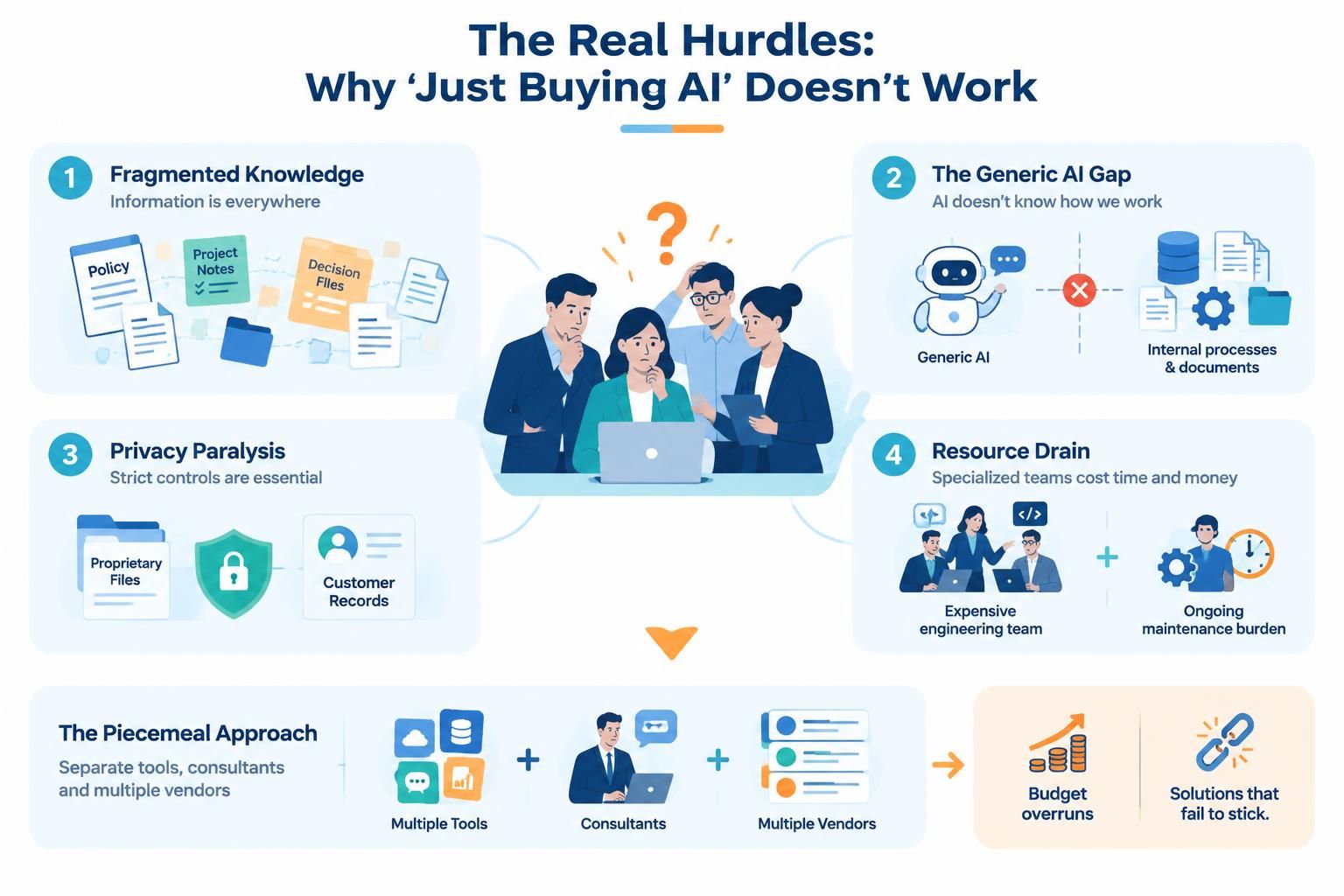
In the current wave of Artificial Intelligence adoption, many enterprises find themselves stuck. The common refrain is simple: “We want AI, but we can’t just plug it into our existing infrastructure.” The infographic The Real Hurdles: Why ‘Just Buying AI’ Doesn’t Work illustrates a critical architectural truth: the problem isn’t usually a lack of interest, but rather a fundamental mismatch between public AI capabilities and the private, complex reality of corporate knowledge.
This tutorial explores the system architecture required to bridge this gap. We will move beyond the concept of “buying” a tool and toward building a Self-Hosted AI Total Solution. This approach treats AI not as a standalone product, but as an integrated layer within the Visual Paradigm Ecosystem, designed to solve the four specific hurdles identified in the context.
The Architecture of the “Generic AI Gap”
The first two hurdles—Fragmented Knowledge and The Generic AI Gap—describe a classic data access problem. Public AI models are trained on the open web, not on your company’s specific project notes, policies, or decision files. If you try to connect a public bot directly to your internal processes without a middle layer, you get generic, often hallucinated answers.
To solve this, we must architect a Knowledge Retrieval Layer. In a self-hosted ecosystem, this layer acts as a specialized index.
- The Ingestion Pipeline: The system must be able to ingest fragmented data sources. This includes unstructured data (PDF policies, project notes) and structured data (decision logs).
- The Vector Store: Once ingested, this data is converted into vector embeddings. This allows the AI to understand the semantic meaning of your documents rather than just matching keywords.
- The Retrieval-Augmented Generation (RAG) Engine: When a user asks a question, the system searches this private vector store first. It retrieves the specific context (e.g., “Project Alpha’s Q3 Notes”) and feeds it to the AI model alongside the user’s query. This ensures the AI answers based on your internal processes.
Overcoming Privacy Paralysis with Self-Hosting
The third hurdle, Privacy Paralysis, is the most significant architectural barrier. The fear of sending proprietary files or customer records to a public API is valid. A “cloud-only” AI solution often violates data sovereignty regulations (like GDPR or HIPAA) because the data leaves your perimeter.
The solution is a Self-Hosted AI Environment. By hosting the Large Language Model (LLM) and the vector database within your own secure network or private cloud, you create a “Walled Garden” for your AI.
Architectural Benefits of Self-Hosting:
- Data Sovereignty: Proprietary files and customer records never leave your infrastructure. The AI model comes to the data, rather than the data going to the model.
- Customization: You can fine-tune the base model on your specific industry jargon and compliance rules, ensuring it speaks your company’s language.
- Controlled Access: You can implement strict Role-Based Access Control (RBAC) at the database level, ensuring that a junior analyst cannot query the same sensitive financial data as a C-suite executive.
Solving Resource Drain and The Piecemeal Approach
The fourth hurdle, Resource Drain, highlights the cost of the “Piecemeal Approach.” Trying to build an AI solution by hiring separate consultants for setup, buying multiple disjointed tools, and managing multiple vendors creates a “Frankenstein” architecture. This leads to budget overruns and a high maintenance burden.
A Total Solution Ecosystem (like the Visual Paradigm AI Ecosystem) consolidates these resources. Instead of managing three different vendors, you manage one integrated platform.
The Unified Architecture Workflow
In this unified model, the “Resource Drain” is mitigated by automation and integration. The architecture flows as follows:
- Unified Ingestion: All tools (chat, document processing, project management) feed into a single central data lake.
- Centralized Governance: One set of privacy controls applies to the entire ecosystem, eliminating the need for multiple compliance audits.
- Scalable Maintenance: Because the environment is self-hosted and integrated, the “ongoing maintenance burden” shifts from fixing broken integrations to managing a single, cohesive system.
Conclusion: From Fragmented to Integrated
The transition from a “Generic AI” to a “Corporate AI” is not a software purchase; it is a system architecture project. By acknowledging the risks of fragmented knowledge and privacy, and by adopting a self-hosted, total solution approach, enterprises can transform their internal data into a strategic asset.
The piecemeal approach leads to failure because it treats AI as a product rather than a process. The successful enterprise will be the one that builds a bridge—secure, integrated, and deeply knowledgeable—between its internal reality and the power of Artificial Intelligence.