
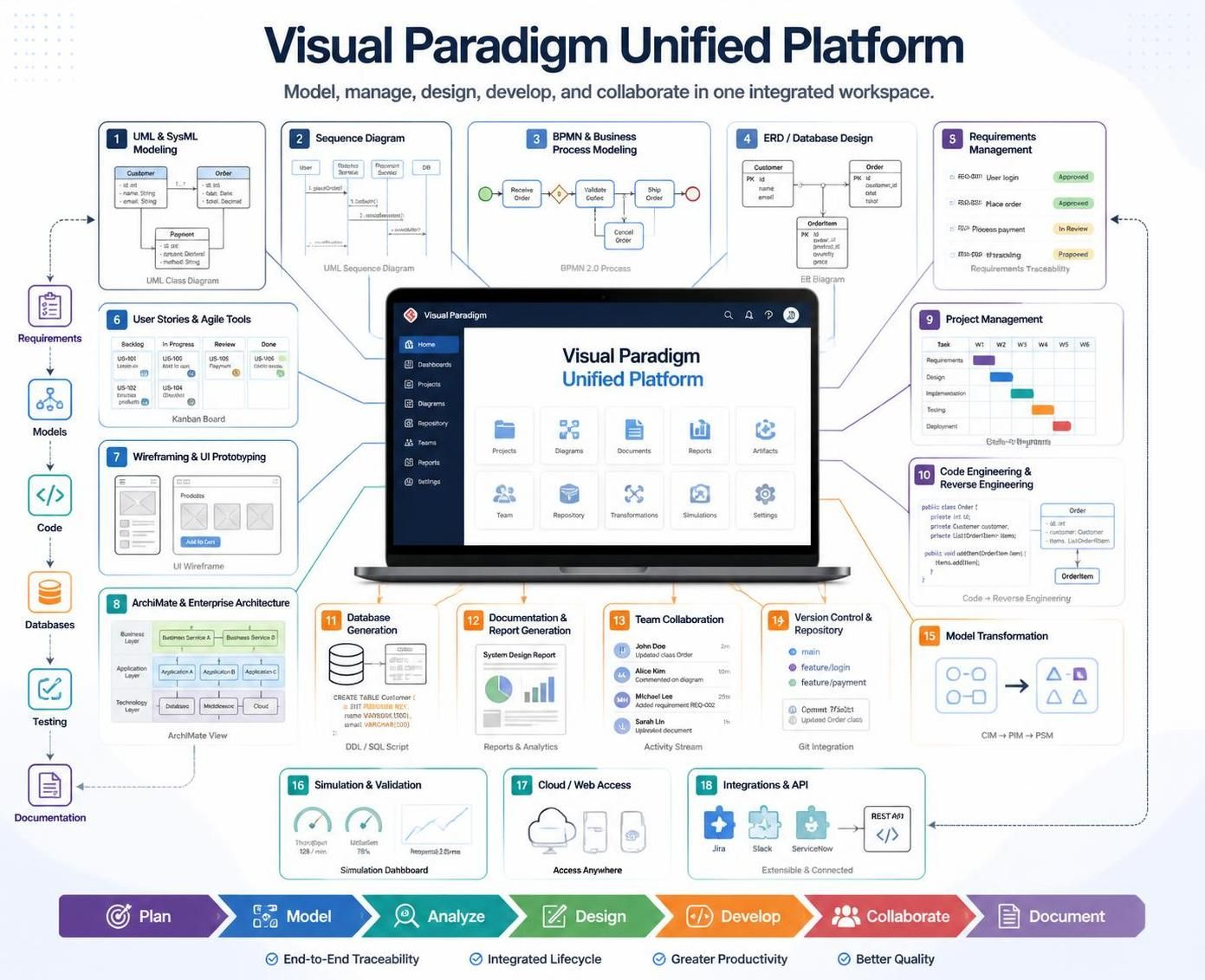
In the modern landscape of software engineering and enterprise architecture, the fragmentation of tools often leads to “islands of information,” where requirements, designs, and code exist in disconnected silos. The Visual Paradigm Unified Platform addresses this by functioning not just as a collection of tools, but as a central orchestrator for the entire system lifecycle. This tutorial explores the architectural philosophy of this platform, how it integrates disparate modeling standards, and the strategic advantages of its AI-enhanced ecosystem.
The Core Philosophy: From Silos to a Connected Ecosystem
The fundamental shift offered by the Visual Paradigm Unified Platform is the transition from a document-centric workflow to a model-centric workflow. Traditionally, an organization might use one tool for UML diagrams, another for database schemas, and a third for project management. The Unified Platform consolidates these into a single, connected workspace.
This architecture is best understood as a central hub connecting Visual Paradigm Desktop, VP Online, and cloud-based applications. Instead of treating diagrams, requirements, plans, code, and documents as separate deliverables, the platform allows teams to connect them throughout the project lifecycle. This ensures that a change in a high-level business process diagram can automatically reflect in the project plan and the underlying database schema.
Deconstructing the Capability Matrix
The platform’s power lies in its ability to bridge the gap between abstract business strategy and concrete technical implementation. We can categorize its capabilities into five distinct architectural layers.
1. Visual Modeling and Enterprise Architecture
At the highest level of abstraction, the platform supports rigorous architectural standards. This is not merely about drawing boxes and lines; it is about creating a “Single Source of Truth” for the system.
- UML & SysML: Essential for software engineering and systems engineering, allowing for class diagrams, state machines, and activity diagrams.
- BPMN 2.0: Business Process Model and Notation allows for the visualization of complex business flows, ensuring that IT systems align with actual operational requirements.
- ArchiMate & TOGAF: For enterprise architects, the platform provides the necessary rigor to map strategic goals to business services, application layers, and technology infrastructure.
2. Requirements and Business Analysis
Before a single line of code is written, the platform facilitates the capture and management of business needs. It moves beyond simple text documents to interactive artifacts.
- Requirements Management: Tools to define, trace, and approve requirements, ensuring that every feature has a business justification.
- Customer Journeys & Use Cases: Visualizing the user’s path through the system to identify pain points and opportunities for improvement.
3. Agile and Product Management
The platform integrates seamlessly with Agile methodologies, bridging the gap between long-term architectural planning and short-term sprint execution.
- User Story Maps & Backlogs: Organizing development work in a way that prioritizes value delivery.
- Roadmaps & Sprint Planning: Visualizing the timeline of delivery and ensuring that architectural debt is addressed alongside new features.
4. Database and Code Engineering
One of the most critical aspects of the platform is its bidirectional relationship with code and data. It supports the full spectrum of database engineering, from conceptual design to physical implementation.
- ERD & Database Design: Creating Entity-Relationship Diagrams to model data relationships.
- Reverse Engineering: The ability to import existing codebases (Java, C#, etc.) and generate models, allowing teams to modernize legacy systems.
- Code Generation: Generating boilerplate code and database scripts (DDL) directly from the visual models.
5. Collaboration and Cloud Integration
The platform is designed for distributed teams. It provides shared workspaces where team members can collaborate on diagrams, manage tasks, and track version control.
- Shared Workspaces: A central repository for all project artifacts.
- Cloud Access: Access work through a web browser, ensuring that stakeholders can view and contribute to the project without installing heavy desktop software.
The Role of AI in the Modeling Ecosystem
The integration of Artificial Intelligence (AI) into the Visual Paradigm ecosystem represents a significant leap in productivity. The platform moves beyond simple syntax checking to “intelligent modeling assistance.”
AI capabilities include:
- Text-to-Diagram Generation: Users can describe a system in natural language, and the AI will generate the corresponding visual model.
- Model Analysis: AI can analyze diagrams for potential logical errors or inconsistencies.
- Diagram Refinement: Intelligent suggestions for layout improvements and style consistency.
Workflow Integration: From Plan to Document
The platform’s workflow is designed to be iterative and continuous. It supports the entire lifecycle:
- Plan: Define the strategy and requirements using business analysis tools.
- Model: Create visual representations of the system using UML, BPMN, or ArchiMate.
- Analyze: Validate the models against requirements and simulate processes.
- Design: Refine the architecture and design the database and API interfaces.
- Develop: Generate code and integrate with version control systems.
- Collaborate: Work together in real-time with team members and stakeholders.
- Document: Generate comprehensive reports and documentation automatically from the models.
Conclusion
The Visual Paradigm Unified Platform serves as a central hub that connects the dots between business strategy, system design, and technical implementation. By providing a connected workspace for visual modeling, business analysis, agile planning, and project management, it empowers teams to build better software with greater efficiency. Whether you are an enterprise architect mapping complex systems or a developer generating code, the platform offers the tools and connectivity needed to succeed in a complex digital environment.